

What are OEM vs ODM? How do they differ, and which one is right for you?
Want to create your own brand and product? In this day and age, it's not difficult. Anyone can do it because there are many tools available that allow you to produce the products you want, both through OEM and ODM. You can start from your personal passion, skills, or knowledge and develop new product options for consumers more easily, without needing your own factory or mass production. But first, understanding the difference between OEM (Original Equipment Manufacturer) and ODM (Original Design Manufacturer) will help you plan your production and build your brand effectively.
What are OEM and ODM? What are the differences?
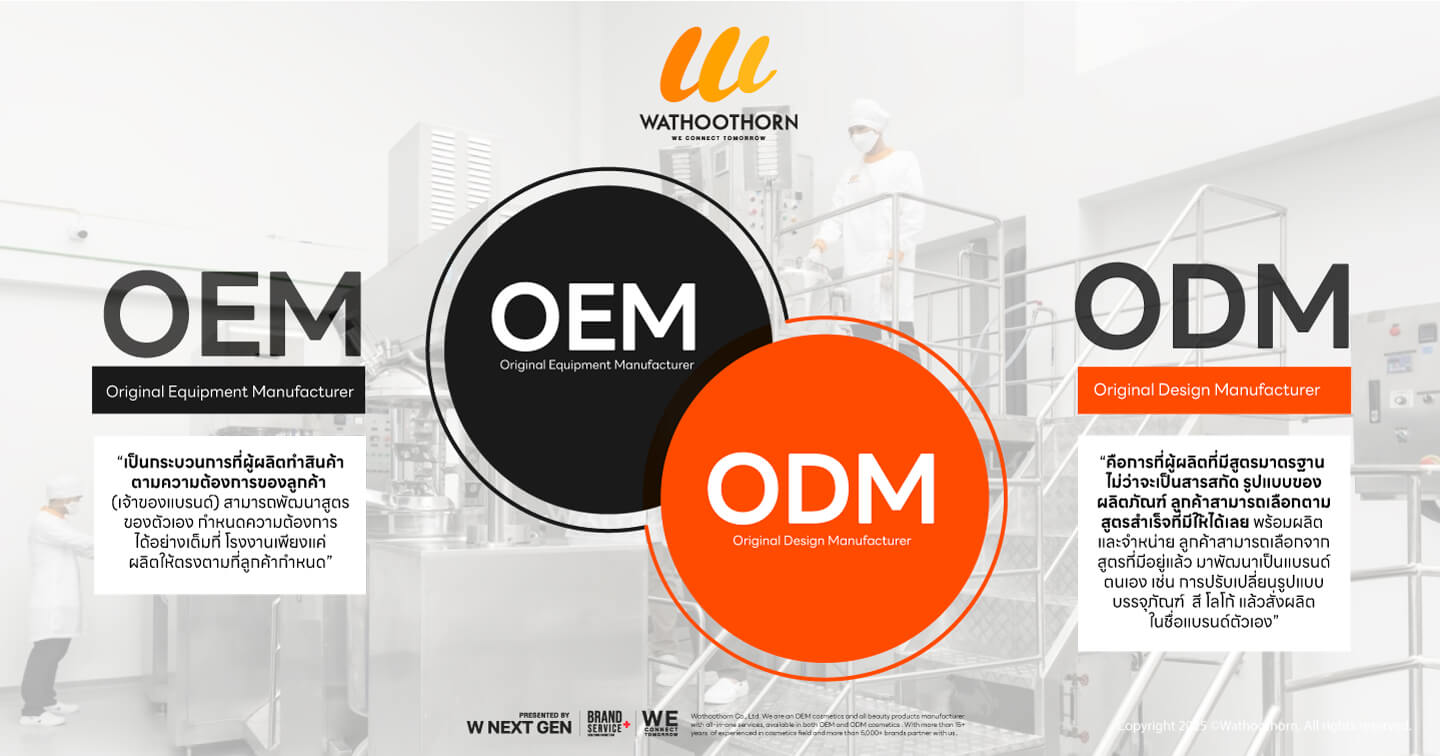
OEM and ODM are popular manufacturing models used in various industries, especially for products that require manufacturing facilities, such as cosmetics, dietary supplements, toothpaste, sunscreen, and more. The main difference between OEM and ODM lies in “who conceives and designs the product.”
OEM (Original Equipment Manufacturer)
OEM (Original Equipment Manufacturer) is a process where a manufacturer produces goods according to the customer's (brand owner's) requirements. The manufacturer can develop their own formulas and fully define their needs; the factory simply produces the goods according to the customer's specifications.
Advantages of OEM
- You have complete control over the design and quality because the brand owner determines every detail of the process.
- The product has a unique brand identity, differentiating it from competitors, allowing for clear differentiation.
- Stand out in the market with a unique formula and design.
- Owning the formula is exclusive, and it can be used as a unique selling point in marketing.
OEM Considerations
- The development costs are high because investment in research and development (R&D) is required.
- The development process takes time, including formulating, testing, and improving quality.
- It is necessary to have a skilled R&D team or hire external experts to participate in the development.
ODM (Original Design Manufacturer)
ODM (Original Design Manufacturer) means that a manufacturer provides standardized formulas, including extracts and product forms. Customers can choose from these ready-made formulas, and the manufacturer will produce and sell the product. Alternatively, customers can select existing formulas and develop them into their own brand, such as modifying the packaging, colors, and logo, and then having the products manufactured under their own brand name.
Advantages of ODM
- It takes less time to build a brand and allows for faster market entry.
- Saves on research and development costs because it uses the factory's ready-made formula.
- You can be confident in the quality of the formula, as it has been tested and certified to meet standards.
ODM Considerations
- The product may be similar to competitors' products that use the same formula.
- There is limited control over the design, especially in terms of formula and properties.
- There may be limitations in customization, such as not being able to change the main ingredients too much.
Comparison table of OEM vs. ODM
| Comparison list | OEM | ODM |
| Production speed | It takes longer because we need to develop a unique formula and redesign it according to your requirements. | Faster, with ready-to-use production formulas. |
| Flexibility | Height is adjustable as needed. | Moderate, depending on the manufacturer's formula. |
| Initial budget | It's expensive because it requires inventing everything from scratch. | Lower value because it uses an existing design. |
| Who is it suitable for? | Brands with unique formulas want a distinctive identity. | Brands that want to get started quickly, without needing to innovate or wait long for production. |
Reasons why you should understand OEM and ODM before creating your own brand.
1. For accurate budget planning.
Understanding the difference between OEM and ODM will help you accurately assess costs. ODM typically has lower costs than OEM because it doesn't require investment in research and development of new formulas, while OEM may have a higher initial investment but offers greater flexibility and uniqueness.
2. To establish a clear brand positioning.
If you want to create a unique and competitive premium brand, OEM is a more suitable option. However, if you need to enter the market quickly with a limited budget, ODM might be a better choice.
3. For quality and standard control.
In an OEM system, greater control over product quality and standards is possible. Raw materials, manufacturing processes, and testing can be customized as needed. ODM, on the other hand, may have some limitations in customization.
Popular product categories in the OEM/ODM market.
- Serums can be formulated in a wide variety of ways to suit different consumer problems.
- Toothpaste is an essential household product used daily, therefore it is in high demand.
- Sunscreen is a beauty routine product that is used regularly, leading to frequent repeat purchases.
- Body scrubs and other products for consumers who pay special attention to their skincare.
- Other types of skincare products include facial cleansers, scar-reducing creams, or cosmeceutical products, as well as makeup that incorporates skincare ingredients.

Guidelines for choosing between OEM and ODM.
When should you choose an OEM?
- When sufficient budget is available. OEM (Original Equipment Manufacturer) requires investment in research, development, and testing, as well as packaging design and production costs. Therefore, it is suitable for those with high initial capital and a willingness to invest for the long term.
- We want to make a clear difference. Ideal for brands that want their products to have a unique identity, both in formula and design, in order to create a distinctive brand image and selling point in the market.
- They have their own technology or innovation. For example, inventing new formulas, using special extracts, or unique manufacturing techniques to add value and gain a competitive advantage.
- There is a long-term plan for developing the OEM brand. This is suitable for those who intend to conduct continuous marketing and want to build a loyal customer base, because high investment will only be worthwhile in the long term of the business.
When should you choose ODM?
- Limited budget, need to enter the market quickly.
ODM (Original Design Manufacturer) helps start a business without R&D investment and reduces production processes, thus enabling market entry in a short time. - We want to test a new market. Alternatively, new products are suitable for those who want to try entering a new market or expanding their product line to see how consumers respond before deciding to invest in OEM development.
- They want to compete primarily on price. Because ODM standard formulas often have lower production costs, they can set lower selling prices than competitors in the market who use OEM.
Examples of choosing between OEM and ODM for different types of products.
- For serums, choosing an ODM (Original Equipment Manufacturer) model is suitable for market testing because it allows for faster product launch, utilizes existing factory formulas, reduces costs, ensures high product standards, and simplifies processes.
- For toothpaste, choosing OEM manufacturing allows for a formula that differentiates it from competitors, adds unique formulas, develops new products, and targets more niche markets.
- For sunscreen products, choosing ODM (Original Design Manufacturer) is easy to start, allows for quick sales, offers a wide variety of formulas to choose from, and helps reduce formula development costs.
- Body scrubs are manufactured via OEM to emphasize unique scents and textures, setting them apart from existing brands in the market.
View all OEM and ODM skincare and cosmetics products here. Click now!
Is it possible to use a combination of OEM and ODM?
Choosing to combine OEM and ODM strategies is an attractive option, and many brands opt for it because it offers greater flexibility in responding to market demands. It's suitable for businesses seeking both long-term differentiation and rapid short-term market response.
The advantages of using a combination of methods.
- Reduce risk in terms of time and investment by using ODM (Original Design Manufacturer) to open markets or conduct trial sales first, while simultaneously developing OEM (Original Equipment Manufacturer) for the long term.
- We can expand our product line by using ODM for mass-market products and OEM for premium or signature brand items.
- To accommodate rapidly changing trends, ODM is suitable for quick product launches to respond to current trends, while OEM is better suited for creating long-lasting products.
Examples of using both OEM and ODM together.
- Start with ODM to penetrate the market. Use the factory's proven formula to launch a market test product and observe customer behavior and needs.
- Develop OEM services for our core products. Once you know what features or styles your target audience prefers, you can develop a unique and highly differentiated formula.
- Marketing on two levels simultaneously.
ODMUsed for affordable products to attract a wide customer base.
OEMUsed for products that need to create a premium image and reputation.
- Rotating ODM products according to the season. Create ODM products based on seasonal events or fashion trends to add freshness without high investment.
Things to know before choosing OEM or ODM.
- OEM takes longer and involves more steps because it requires developing new formulas and continuously improving the product. ODM, on the other hand, reduces the formula development and testing phases, resulting in a shorter timeframe.
- The OEM registration process with the Thai FDA requires complete formula information to be submitted to the FDA.
For ODM (Original Design Manufacturer) projects, factories usually have the necessary information readily available for submission. - Product performance testing is used to increase reliability, such as laboratory testing or real-world testing with a sample group (user testing).
- Required standards include GMP (Good Manufacturing Practice), a basic manufacturing standard, or ISO 22716, an international standard for cosmetics, to certify product quality and build brand credibility.
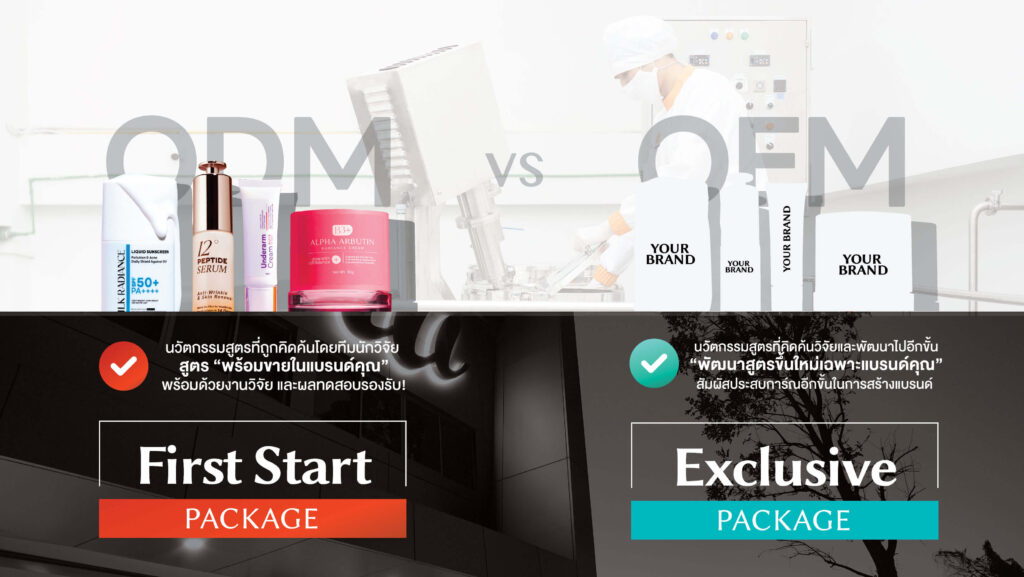
In short, which type of OEM or ODM is right for your brand?
There's no right or wrong answer to choosing between OEM, ODM, or both for brand building. The key is having a clear brand communication strategy to avoid customer confusion about the brand's core products. In terms of products, a consistent quality management and standards plan is essential for effective brand growth. Ultimately, it all comes down to: what are your brand building goals?
Consult with Wathoothorn for OEM/ODM brand creation and complete manufacturing facilities.
Cream manufacturing factory Wuthuthon We can help you become a brand owner more easily. We offer a wide range of product manufacturing services, not just creams, but also comprehensive skincare brand manufacturing, including serums, toothpaste, sunscreen, and body scrubs. We offer both OEM (Original Equipment Manufacturer) services, where our team of expert researchers helps develop new formulas and selects extracts to meet all your needs, and ODM (Original Design Manufacturer) services for brand owners who want to start their brand easily and quickly. Cream manufacturing factory Wathoothorn offers a complete range of skincare and cosmetic products, from formula creation and development to packaging design. Brand owners can choose the branding model that best suits their needs.